



Our friendly team of pump experts can be reached Monday through to Friday from 8:30am to 5pm.
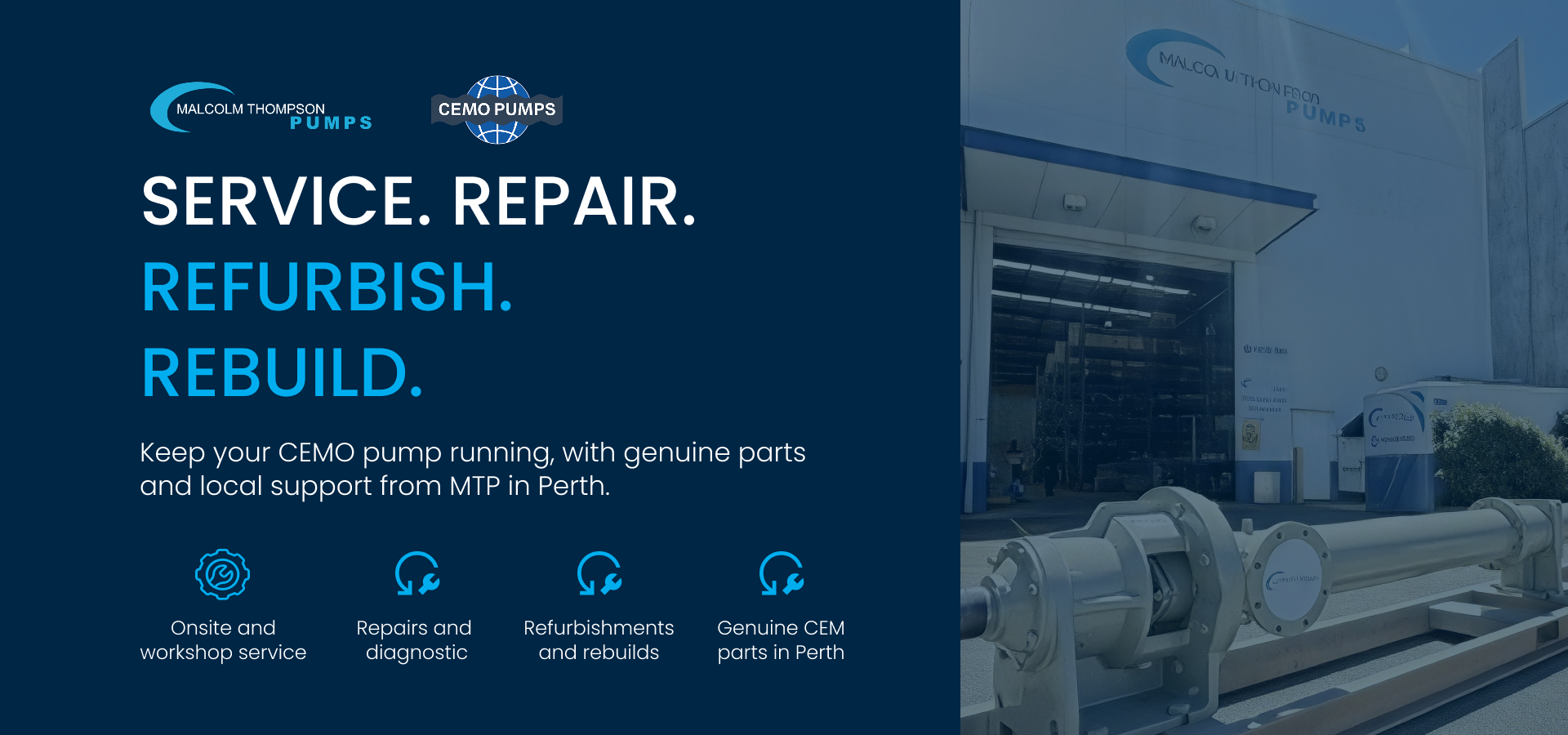
The simplest way to keep a CEMO underground dewatering pump running is to service it on a schedule, fix wear before it becomes a failure, and use genuine CEMO parts when components are replaced. Malcolm Thompson Pumps (MTP) now handles all of that locally, with genuine CEMO parts held in Perth and a technical team that already supports WA mine sites.
CEMO progressive cavity pumps have been dewatering Australian underground hard-rock mines for more than 25 years, and many WA sites still run them. MTP is now the exclusive CEMO distributor in Western Australia, with distribution rights across Australia. This post covers what that means for the pumps already on your site: how to look after them, what to do when one is struggling, and where to get parts without waiting on overseas freight.
Why dewatering pump uptime matters underground
When a dewatering pump stops underground, water starts backing up into the workings, and the cost is measured in lost production rather than the price of the pump. A sump that floods can stop access to a level, delay development and tie up maintenance crews on an unplanned callout.
Progressive cavity pumps like CEMO's are well suited to this work because they handle dirty water and abrasive solids at a steady flow. The trade-off is that the parts doing the pumping, the rotor and stator, wear in contact with that abrasive water. How quickly they wear depends on solids content, run hours and whether the pump ever runs dry. Managing that wear is what keeps the pump available.
Service, repair, refurbishment or rebuild: which does your CEMO pump need?
The right level of work depends on how far the wear has gone. Catch it early and a service is enough. Leave it, and a minor job becomes a rebuild.
|
Level of work |
When it fits |
What MTP does |
|
Service and maintenance |
The pump is running normally and is due for scheduled attention |
Inspects wear parts, checks seals, bearings and drive alignment, and replaces consumables before they fail. Done on site or in the workshop. |
|
Repair |
Something has failed or performance has dropped, such as a leaking seal or falling flow |
Diagnoses the fault, replaces the failed parts with genuine CEMO components and returns the pump to service. |
|
Refurbishment |
The pump has done long hours and several wear parts are near the end of their life |
Strips the pump and replaces the rotor, stator and other worn components together, then hydrostatic pressure tests it before return so it won’t leak once it’s back underground. |
|
Rebuild |
The pump is badly worn or damaged, or has been out of service for a long time |
A full teardown and rebuild to CEMO specification, replacing everything that is not fit to go back underground. Each rebuild is hydrostatic pressure tested before return. |
Signs your CEMO pump needs attention
Falling flow or pressure at the same speed usually means the rotor and stator are worn and slipping. Other signs to act on are rising motor current, new noise or vibration, leaks at the seal, and any time the pump has run dry. A stator that has run dry can be damaged in minutes, so it is worth having it checked even if the pump seems fine afterwards.
Service exchange keeps the sump pumping
If a pump needs to come out for a refurbishment or rebuild, MTP's service exchange program lets you swap in a replacement unit so dewatering continues while the original is in the workshop. Hire units are also available for short-term cover.
Genuine CEMO parts, held in Perth
Genuine CEMO parts are now stocked in Perth, so WA sites no longer have to wait on parts shipped from overseas. MTP holds CEMO rotors, stators and other critical wear parts locally, and has direct access to the manufacturer for anything outside regular stock.
The rotor and stator in a progressive cavity pump are made as a matched pair. Their fit determines how much the pump delivers and how quickly it wears. A non-genuine stator that is slightly too tight runs hot and wears fast; one that is slightly loose slips and loses flow from day one. Genuine CEMO parts are made to the original specification, so the pump performs as it was designed to and the next service interval is predictable.
When you call MTP for CEMO parts, have the pump model and serial number ready. That lets the team confirm the right components and check Perth stock straight away.
Local technical support from MTP
MTP has supplied and serviced pumps for Australian mining, industrial and municipal customers for more than 50 years. Its Perth branch at Perth Airport supports WA mine sites directly, with a second workshop in Seven Hills, Sydney.
For CEMO pumps, that support covers:
- on-site and workshop servicing and maintenance
- fault diagnosis and repairs
- refurbishments and full rebuilds, hydrostatic pressure tested before return
- genuine CEMO spare parts from Perth stock
- service exchange and hire units
- advice on pump selection and specification when a pump is due for replacement
The practical difference is having someone in the same state who knows the pump. When a CEMO pump starts losing flow, a maintenance or reliability engineer can talk it through with MTP the same day, rather than chasing an overseas supplier across time zones.
Talk to MTP about your CEMO pump
Whether your CEMO pump is due for a service, losing flow, or needs a rebuild, the MTP team in Perth can help. Call 1800 733 687, Monday to Friday, 8:30am to 5pm, or book a service or repair
Read also: Malcolm Thompson Pumps announces partnership with CEMO Pumps